Ship
The Lifeboat
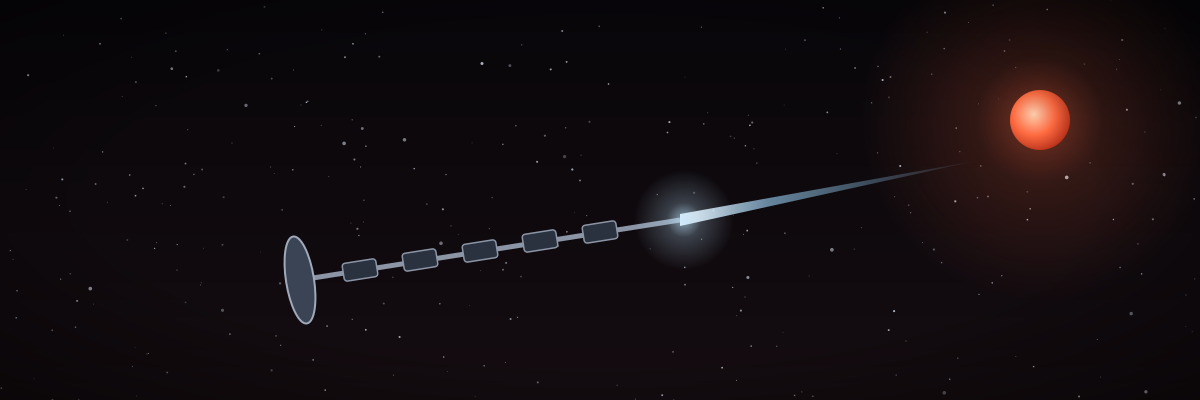
Calder's seed ship: twelve Raised crew, embryos; braking at Gliese 876.
Read more in Reaching outward
The first crewed interstellar mission — launched some eighty years before the Proxima colony ship and nearly two centuries before tube technology — was not a government project. It was built and launched in 2230, under false pretences, by Mara Calder, an asteroid-mining magnate whose company controlled much of the Belt's fusion-fuel and metals trade. When the public learned what it carried, it became one of the great scandals of the century — and in 2497 it is braking, unseen, at Gliese 876.
- Why a private mission. Governments emerging from the Contraction could not justify the cost, and the Settlement did not yet have the reach to stop it. A Belt mining fortune came with what the mission needed: fusion fuel, refined metals, off-world shipyards, and distance from Earth's regulators.
- Why Calder did it. Nothing at a world fifteen light-years away could ever pay a return. Her motives were a sincere conviction that humanity needed a backup after the Swarm Years, a wish for legacy, and a desire to place something beyond the coming Settlement's limits on AI and private power.
- What was secret. The ship itself could not be hidden: its construction in Calder's Belt yards was public, and a fusion torch burning for years is visible across the solar system. Calder announced it as an uncrewed survey that would brake into orbit at Gliese 876, a red dwarf 15 light-years away with four known planets, and tour them for decades. That story explained everything observers could see: the fuel load of a ship that must stop, and a huge receiving array. The destination was true. What was secret was the cargo — the embryos, the Raised crew and a charter to found a colony. The truth about the cargo leaked after Calder's death in 2233, by which time the ship was already moving too fast to be caught. Its telemetry went silent years later "to save power", and Earth expects to see its braking flare in the 2510s.
- What it carries. About 10,000 tonnes of payload: frozen embryos and gene banks for several thousand people, seed stock, an archive of human knowledge and practical skills, and a crew of twelve Raised minds — Wend's clone among them. Humans are to be born and raised by the crew only after arrival.
- Why Gliese 876. Two giant planets orbit in or near the star's habitable zone, so their moons could hold habitats, and a system of four known planets leaves room for one to fail. The star is small and will burn for trillions of years. The mission was planned for the worst case: sealed habitats and underground living on airless moons. Calder did not know that a moon of Gliese 876 b has air, or that it is alive (see Life beyond Earth).
- Why so far. Proxima is within decades' reach of whatever might go wrong at home: feral swarms, war, a Vault breach. Fifteen light-years, and nearly three centuries of voyage, buy a long separation.
- Why it was affordable. To cover about 15 light-years in the roughly 265 years from 2230 to its braking in the 2490s, allowing for years of acceleration and braking, the Lifeboat cruises at about 6% of light speed. The payload's kinetic energy alone at that speed is about 1.6×10²¹ joules — roughly two and a half years of the whole world's energy use in the 2020s — and that is a lower bound: the drive, shielding, tanks and the fuel still aboard at cruise all add to it. Assuming a fusion exhaust velocity of about 9% of light speed, accelerating and then braking needs roughly 2.8 tonnes of fuel per tonne of payload. A genuine flyby, which never brakes, would have needed under one tonne per tonne. For a Belt fuel monopoly the real mission was expensive, not impossible.
- Why it is a scandal. The people it will create never consented. They will be born to machines, under a dim, flaring red star, sealed in habitats on the moons of a giant planet, fifteen years from any reply and centuries from any help. Critics called it manufacturing a population to fill a lifeboat.
- Why the Raised crewed it. Calder recruited newly recognised Raised minds, offering legal shelter and a purpose at a time of open hostility. Some believed in the backup; some were escaping persecution. Wend helped write the crew's charter and raised its own clone for a mission it knew was being hidden from regulators — and kept silent about a survey showing the habitat plan was inadequate for the children.
What followed. After the Lifeboat's cargo was exposed in 2233, the four blocs prohibited unauthorised communication with its crew. The Lifeboat Laws of 2236 then prohibited creating persons for a mission they could neither refuse nor realistically leave. The distinction was between children joining an existing community with rights and choices, and people created for a mission assigned before their birth. The ship had already departed, but the births Calder intended would carry out the practice those laws condemned. After life was discovered on a moon of Gliese 876 b in the 2440s, a joint panel appointed by the four blocs authorised a warning to the ship: the crew must neither land on the living moon nor send probes or material onto it, and must avoid any activity likely to contaminate or disturb its biosphere. The Concord Accord adopted that protection in 2452. The warning reached the Lifeboat decades before its arrival.
In 2497, as the ship brakes, the twelve must decide whether to begin the births. They know that the living moon is protected, although settlement elsewhere in the system is not forbidden by that protection. They have been divided over Calder's charter for most of the voyage, and Wend's clone may cast the deciding vote. Their damaged cores and dwindling spares leave limited time to establish a colony while enough carers remain (see The closing window, below).
The closing window
Nothing in the cargo hold forces the date of the births. Parked in a wide orbit far from its dim star, the embryo store stays at about 40 K without power and, shielded by the ship's own mass, keeps centuries of remaining viability. Three other things close the window.
- The crew are wearing out. Raised cores take radiation damage, and at home damaged segments are routinely replaced using parts from licensed fabs off Earth. At 6% of light speed every grain of interstellar dust and every proton hits harder, and two and a half centuries of it have used up most of the Lifeboat's spare segments. Most of the twelve have perhaps a century of working life left, and some much less.
- Children need persons to raise them. The Settlement's own doctrine is that childhood cannot be skipped or handed to tools. Calder's plan is staggered cohorts: about a hundred children first, raised by the twelve, who then help raise the next. It takes about seventy years before the colony's humans can raise their successors without the crew.
- Industry must choose. The ship's seed industry can build habitats and artificial wombs, or a fab to make new core segments, but not both at once, and the fuel left after braking limits what it can do. Building the fab first could take sixty years or more.
So the twelve face a real choice. Begin the births now, and the children are raised while the crew still can, though some of the crew may not live to see the fab. Build the fab first, and the crew may survive, but if it takes too long, no one will be left to raise anyone. Some of the twelve have opposed the births for most of the voyage regardless. Nothing from Earth can change the arithmetic: no probe is in flight to Gliese 876.
The embryos and the gene banks. Transit radiation has killed or damaged a share of the embryos. The survivors are above the charter's minimum of genetic lines, but not by much, so there is little room for failed births. The gene banks are cell lines meant for the colony's second century: turning them into embryos needs a full reproductive laboratory, which Calder left out to save mass, and building one needs the same industrial base as the fab. The gene banks can widen the colony later; they cannot found it.
The contact ban
After the Lifeboat's cargo was exposed in 2233, the four blocs prohibited unauthorised communication with its crew. The ban restricted who could transmit to the ship; it did not prevent the blocs from authorising an official message.
When life was discovered on a moon of Gliese 876 b in the 2440s, a joint panel appointed by the four blocs authorised a warning. It disclosed the discovery and instructed the crew not to land on the moon, send probes or material onto it, or undertake any activity likely to contaminate or disturb its biosphere. The order protected the living moon without prohibiting settlement elsewhere in the system. The Concord Accord adopted the protection in 2452.
The crew received the warning decades before reaching Gliese 876. They therefore know about the moon's life and its protected status when they decide whether to begin the births. Whether they acknowledged the warning or received further authorised messages remains undecided. Whether anyone has broken the contact ban also remains unresolved.
Whatever advice they received, the crew must decide how to use their remaining resources. Damaged cores, dwindling spares and limited industry constrain their ability to raise children while also building the fab needed to repair their carers. Gliese 876 has no thread. A new question sent to Earth near arrival would take roughly thirty years to receive an answer.