Chapter 22 · Beyond Earth
Life beyond Earth: the wall still forming
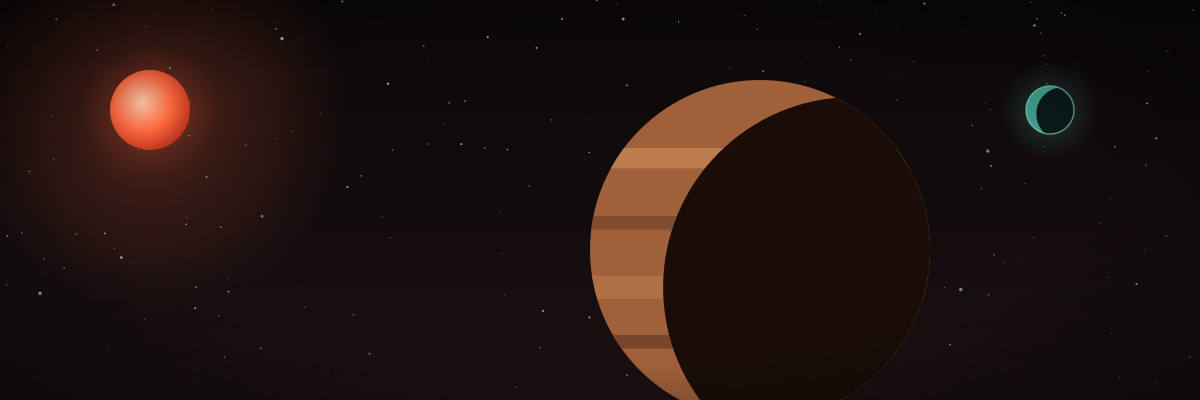
For three centuries, every discovery has told the same story: simple life is everywhere, complex life is nowhere. Microbes have turned up in the solar system and on worlds around other stars, but never anything more — and astrobiologists increasingly conclude that the great filter was endosymbiosis, the ancient merger of two microbes that gave Earth its complex cells. The newest find fits the pattern: a moon of Gliese 876 b, the Lifeboat's destination, has oxygen air made by microbes. Whatever stops minds from arising seems, for now, to lie behind us.
The Lonely Wall (2120s–2497)
| When | Discovery |
|---|---|
| 2190s | Mars samples, returned at last from the Settlement's side of Mars once the Contraction ended, confirm ancient Martian microbes, chemically distinct from Earth's — a separate origin. Life starts easily |
| 2200s | Cloud surveys find no life on Venus: the phosphine reported in 2020 was non-living chemistry. A cloud deck cannot be proved empty, so the Venus Question stays open (see Reaching outward) |
| 2210s | Living microbes are found in Enceladus's ocean plumes |
| 2260s | Europa's ocean is confirmed inhabited — by microbes only |
| 2400s on | Giant telescopes, including lenses that use the Sun's gravity from hundreds of AU out, find microbial biospheres on roughly one habitable-zone world in ten around Sun-like stars. A handful have oxygen-rich air, but oxygen alone proves nothing: Earth's microbes made oxygen for two billion years before complex life appeared |
| 2430s–2440s | Sun-lens telescopes find oxygen air on a moon of Gliese 876 b, the giant planet in the habitable zone of the Lifeboat's target star. Its spectrum shows the oxygen is biological: microbial life, like every living world found so far |
| — | Proxima b, the red-dwarf world humanity settled, is classified sterile under surface surveys: its atmosphere was stripped by stellar flares, and no indigenous life has been detected |
By 2497 this is hardening into the Lonely Wall consensus: life is common, but as far as anyone can see, it almost always stays microbial. Earth's single ancient merger was the great filter, crossed by luck two billion years before anyone existed — which makes humanity and the Raised custodians of the only complex life, and the only minds, in reach. A minority of astrobiologists warn that the surveys read atmospheres, not oceans under ice, so the wall may be partly a bias of the instruments.
The Gliese 876 moon
- Where. Gliese 876 is a red dwarf 15 light-years away with four known planets. Its giant planet b orbits in the star's habitable zone, and one of its moons holds a breathable-looking atmosphere. Calder chose the system for its planets in the 2220s and did not know of the moon.
- What. Microbial life, inferred from the chemistry of the air rather than seen. Nobody knows what lies under it; no probe has gone, and none may.
- Protected. After life was discovered in the 2440s, a joint panel appointed by the four blocs sent the Lifeboat an authorised warning against landing on the moon, sending probes or material onto it, or contaminating or disturbing its biosphere. In 2452 the Concord Accord adopted the protection. That is why no colony fleet of the 2470s heads for the moon. Settlement elsewhere in the system is not prohibited by that protection, but Calder's planned births remain the practice condemned by the Lifeboat Laws (see The Lifeboat, in Reaching outward).
Veil
A giant planet around Alpha Centauri A was first glimpsed as a candidate by the James Webb Space Telescope in 2025. Later surveys confirm it, and find it has a large moon, Veil, with a thick ice shell over a tidally warmed ocean. Lantern Probe flybys imaged it in the 2150s, and surveys from Proxima, only 0.2 light-years away, have mapped its hidden ocean — but from outside, all anyone can see is ice, and life sealed under kilometres of it would leave no trace a telescope can read. Since life was found in Enceladus and Europa, the Settlement has banned penetrating any alien ocean until a probe can be certified sterile, and since the 2450s the Concord Accord's ban on disturbing alien biospheres has bound every bloc, so nobody has looked inside.
Where the filter must be now
- The Wall school. The filter is behind us: the merger that made complex cells is the improbable step, and Earth crossed it by luck. This is the Lonely Wall consensus, and the dominant reading in 2497.
- The Rare-Mind school. The filter lies between animals and minds. Earth took about 500 million years to get from its Cambrian explosion to minds. Its critics point out that nobody has yet found an animal anywhere else to test it on.
- The Narrow-Gate school. Minds arise and then destroy themselves at the transition to AI, as the twenty-first-century astronomer Michael Garrett proposed, and humanity is a rare survivor. Its newer adherents add a second gate: the moment a civilisation learns to turn its star into a weapon. The Swarm Years, the Caloris Runaway and the standoff have made it the Wall school's strongest rival in the Settlement, and its strongest argument for keeping every restraint.
- The Quiet school. Others survived and chose silence. A minority view.
- The Limits school. We have searched only a few thousand light-years of a galaxy 100,000 across, and civilisations that last centuries may never overlap in time. The silence proves less than anyone claims.
Consequences in 2497
- Fear of the filter is a live political force. Whether the gate is behind or ahead is argued in every debate about the arrays; the Narrow-Gate school's rise has been fed by the Caloris Runaway and by every crisis of the standoff.
- The moon is untouchable. A second, independent biosphere could be ruined by a single contaminated landing. Who would enforce the Accord's protection at fifteen light-years, when the Anchorage has no fleet even at home, is a question nobody can yet answer.
- Faith absorbs a quiet result. Every faith and faction must live with life that is common and minds that, as far as anyone can see, are not.
- The Lifeboat's dilemma sharpens. Calder's charter assumed airless moons. The crew received the official warning decades before arrival and know that the living moon is protected. They must decide whether to begin the births and how to establish a colony elsewhere in the system without disturbing its biosphere (see The contact ban, in Reaching outward).