Institution
The Elevator
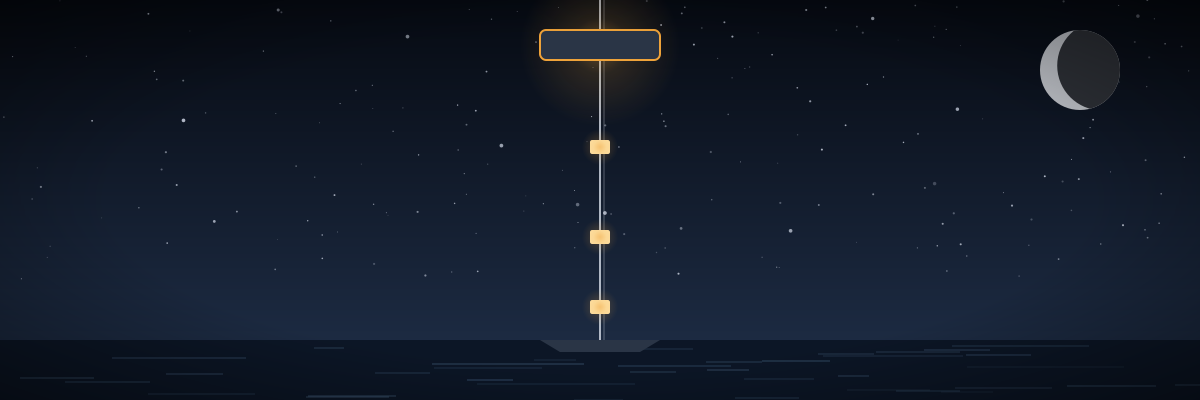
Earth's first space elevator (2271), on a platform off the Galápagos; four partners.
Read more in Reaching outward
The Elevator is Earth's first space elevator: a cable from a platform on the equator to a counterweight about 100,000 km up, opened in 2271. The Settlement, the Mandate, the Parishad and the Open Cities built it together, the first great project the blocs shared after the Contraction. For two centuries it carried most of Earth's traffic to orbit, and it began as a symbol of cooperation before becoming one of their sharpest quarrels.
The Sweep (2170s–2240s). No elevator cable could cross a debris belt, so the Elevator waited for the sky left by the Shattering of the 2080s to be cleared. The Sweep was the first lasting project the future blocs ran together. Ground lasers burned the surface of fragments so that they dropped and burned up; drag sails were fitted to dead satellites; robotic collectors cleared the high band, where nothing falls on its own. Much of the low band had decayed by itself, but the White Night of the 2140s added a new layer of dead satellites, and the low band was clear only in the 2180s, in time for the early Great Lift to run, slowly, on rockets and fusion shuttles. The high band took sixty years more. A laser that can drop debris can also blind a satellite, so the Sweep ran under mutual inspection: the Sealing Treaty's first test off Earth. The Elevator Treaty of 2244 was signed in the year the Sweep's last high-band survey came back clean, and its drafters added the Sweep to their precedents (see Who built it, below). The Landing still keeps the orbits around every cable clear, and leaving junk in orbit is an offence under every bloc's law. Why it could be built. The cable needs a strength-to-weight ratio about ten times that of the best fibres of the 2020s, such as Kevlar and Zylon. Carbon nanotubes and graphene had it in the laboratory but not in bulk until the Embodied Wave's materials laboratories learned to make them by the kilometre in the 2230s. Fusion supplied the rest: lifting a kilogram to geostationary height takes about 14 kWh, which climbers draw from power beamed up the cable.
Who built it. Under the Elevator Treaty of 2244, the Settlement and the Mandate each paid about 35% of the cost, and the Parishad and the Open Cities 15% each, and each holds that share of climber slots. The Open Cities' small share came with the site: a floating platform in the waters of the Galápagos, an Open City of the Cordillera Republic, on the equator west of the islands and about 1,200 km from mainland Ecuador. Storms and lightning are rarer in the eastern equatorial Pacific than anywhere else on the equator, which is why elevator studies of the 2000s had already chosen it. The treaty's drafters cited two precedents from the early twenty-first century: the International Space Station, which outlasted decades of rivalry, and the ITER fusion reactor, built jointly by Europe, China, India, the US, Russia, Japan and South Korea.
How it was built. A seed ribbon was spun out from geostationary orbit in both directions: down to the platform, and up to a small captured asteroid that serves as the counterweight. Climbers then thickened it, each adding ribbon as it rose, for about twenty years. The station at geostationary height, 35,786 km up, is the Landing.
Riding it.
- A week up. The first climbers ran at about 200 km/h and took seven and a half days to the Landing. Faster climbers would strain and wear the cable, not the power supply, so speed rose only as cables improved.
- The radiation belts. Days of the trip pass inside the outer Van Allen belt, about 13,000–60,000 km up. Passenger cabins are heavily shielded and cost far more than freight. The poorest emigrants rode lightly shielded freight climbers, called steerage, and paid with a lifetime's dose of radiation.
- No stops below the Landing. Anyone who leaves the cable lower down falls, because they are moving far below orbital speed. From the Landing, fusion ships take over, and cargo released from the far end is flung towards the Moon or the Belt without fuel.
- Mostly up. Goods made in orbit come down cheaply by air braking, so the Elevator mainly carries people, habitat equipment and living things upward. Descending climbers brake regeneratively and return power to the line.
- Capacity. It opened with one ribbon and about six climbers a day. By the 2320s six ribbons and 100-tonne climbers carried about five million tonnes and a million people a year: most of the Great Lift's freight in its last decades, and most of the poor who went. Ribbons were added and climbers sped up until, by the 2430s, it carried about six million people a year, most of the emigrants behind the 3 billion off Earth.
| When | What happened |
|---|---|
| 2170s–2240s | The Sweep clears the debris belt |
| 2244 | The Elevator Treaty is signed |
| 2250s–2271 | The seed ribbon is lowered and thickened |
| 2271 | The Elevator opens; its anniversary becomes Lift Day |
| 2320s | Six ribbons; about a million people a year |
| 2340s | The birth cap: Lines buy Open City slots to leave Earth |
| 2410s | 500 km/h climbers cut the trip to three days |
| 2430s | More ribbons and faster climbers; about six million people a year |
| 2443–2449 | The Elevator Crisis: idle for six years during the Ore Secession |
| 2449 | The Elevator Protocol makes the Landing a joint zone |
| 2488, 2496 | The Mandate's and the Settlement's own elevators open |
Where the tension came from.
- Inspection. Compute licensing depends on registering every chip, so Settlement and Mandate inspectors search all freight on the platform. The hosts resent foreign inspectors in their waters, and are suspected of letting unlicensed hardware through.
- Slots. The shares were fixed by 2244 money and never matched later demand. After the birth cap of the 2340s, Lines bought Open City slots to leave Earth, and the Settlement accused the hosts of selling exits from the cap.
- The Elevator Crisis (2443–2449). In the Ore Secession the Settlement and the Open Cities, each fighting to keep its own Belt worlds, demanded that all Belt-bound freight be stopped; the Mandate and the Parishad, whose own Belt habitats still depended on it, refused, and the Elevator Treaty bound the hosts to carry every partner's slots. Settlement crews seized the Landing and halted transfers, and the hosts, refusing to let another bloc hold their Elevator, stopped the climbers in reply. The Mandate mediated in public. The Elevator Protocol of 2449 made the Landing a joint zone crewed by all four partners, none of which may halt the Elevator alone. Since 2452 the Landing has also been the seat of the Anchorage. The bloc elevators. After the Crisis, neither the Settlement nor the Mandate would depend on a shared cable again. The Mandate opened its own in the equatorial Indian Ocean southwest of Sumatra in 2488, and the Settlement its own in the equatorial Atlantic, about 1,000 km off Gabon, in 2496. In 2497 the Settlement and the Mandate each run one of their own, both brand new. The Elevator is still the only shared one, and the Parishad's and the Open Cities' only stake in Earth's routes to orbit. It carries cheap freight and the poor, its slow decline has begun, and "the Elevator" still means only the first.
The Moon and Mars. Lunar elevators need only fibres close to those of the 2020s, so they came first: the Settlement's on the near side, through the Earth–Moon L1 point (2210s), and the Mandate's on the far side, through L2 (2230s). Both stand on the lunar equator, far from the polar bases, and lift Moon-made metal to the Great Lift's shipyards. Mars's low gravity makes an elevator easy, but its moon Phobos crosses the cable's path. The Pavonis Mons elevator (2390s), on the equator south of the northern frontier, was built jointly by both halves of Mars, and its cable is flexed to swing clear of Phobos about twice a day.