Event · era
The standoff
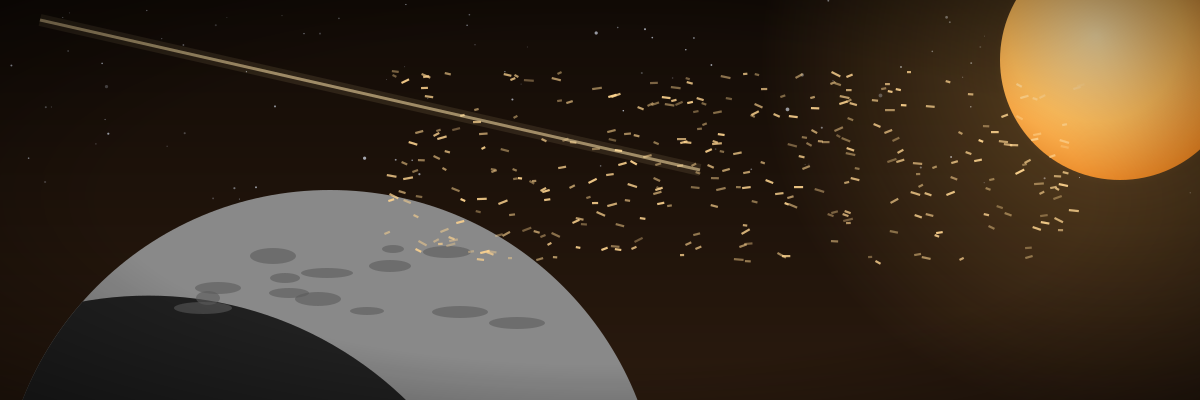
Peace by mutual vulnerability: every habitat within reach of someone's sun.
Read more in The Mirror Race
Since 2452 the peace has rested on mutual vulnerability: every habitat is within reach of someone's sun, and everyone knows it.
- A weapon before an economy. Aiming a beam is easier than building emitters, receivers and radiators across the system, so the early arrays were mostly threat. Within each bloc, delivery lags only by that build-out and is catching up by 2497. Between blocs, beamed power barely flows, except for the share each array pays Freehold for its crews.
- An inequality between blocs. Each bloc's worlds live on their own bloc's array, so the gap between array sizes has become an economic inequality as well as a military one.
- Worlds keep their own fusion. Even within a bloc, no world gives up its reactors, because the Accord's split keys can cut any beam. Like Europe on Russian gas, a world that takes a beam gets cheaper power and hands someone a lever. Titan and the Belt guard their fusion as energy sovereignty.
- Mercury is the system's furnace. Energy-hungry industry has moved there and ships its products out, carrying energy in goods rather than beams. Whoever controls Mercury matters enormously.
- Abundance stays partial. Earth's waste-heat limit keeps the homeworld recognisable: about 2,000 TW warms it roughly as much as doubling CO₂. Licences, compute, brain renewal, transit times and positional goods stay scarce (see Where the wealth is, in Economy).
The Storm Protocol (2460). After the Mercury Storm of about 2457 the signatories added a protocol on solar storms. A ring of sentinel probes inside Mercury's orbit gives hours of warning; on warning, mirrors turn edge-on and Elevator climbers park in shielded bays; every habitat keeps a storm cellar; and Earth's grids hold spare transformers by treaty. Nobody knows the Sun's worst case, and the fear of a superflare larger than anything in the record is one of the few dangers every bloc takes equally seriously. A storm warning is also the one time every array may legally turn edge-on, which is how arrays hide their capacity, so inspectors dread the drills as much as the storms. What the standoff has seen. In the 2460s the Open Cities linked their small Vaults for the first time, using Vault engineers hired away from the Settlement and the Parishad. In the same decade the Settlement and the Mandate closed the Open Cities' new Martian city's routes to orbit in the Hellas Crisis, the standoff's sharpest quarrel off Earth (see Hellas, in Reaching outward). In the 2470s array-powered lasers pushed five light seed ships to about 9% of light speed: the Mandate's three, one Line ship and one Belt Republic ship (see Reaching outward). The same decade brought the standoff's closest call on Earth, the Brahmaputra Crisis, when the Mandate held back the river in a drought year and both blocs put their arsenals on alert (see The Parishad). In the 2480s the Vesta Crisis showed the Belt Republic's lever wearing thin: when the Parishad began hauling its own ice from beyond the Belt, the Republic cut off Vesta's ice and fuel, and the Anchorage brokered terms while Ceres lay under the Parishad's mirrors (see Vesta, in Reaching outward).
In 2497. The largest array, probably the Mandate's at about 45–60 TW, roughly matches all off-Earth fusion, about 60 TW. The Open Cities' collects about 11–21 TW, the Parishad's about 5–10 TW and the Settlement's about 4–5 TW. Growth is beginning to slow as inspection falls behind the fabs, so the doubling times above are averages over the race. Every bloc can still see full abundance coming beyond the end date, and every bloc fears whichever one breaks the industrial-controller supply limit first. The newest school of historians, the deterrence school, credits fear for the peace (see Who tells this history, in The long middle).